Saturday, January 5, 2013

A New Historical Thriller

The Yard  by Alex Grecian

"Nobody noticed when Inspector Christian Little of Scotland Yard disappeared, and nobody was looking for him when he was found."  

This is a great opening line for the start of a historical thriller. 

The Place:  Victorian London.  The date:  1889, Jack the Ripper's reign of terror is finally over.  However the city of London is not resting easily, since the Ripper was never apprehended.  Scotland Yard is scrambling to deal with the ever increasing murder rate in London, by establishing a "Murder Squad".  Since they were unsuccessful in tracking down "Saucy Jack", you might say the Yard is also dealing with a public relations problem in addition to the growing crime rate.  The people of London don't trust the police, and now someone is killing them. 

Grecian grabs your attention with that opening line, and does a fairly decent job of building suspense and introducing several interesting characters.  This is Alex Grecian's first novel, and he loses some of the suspense or it begins to lag, when he starts each subsequent chapter bouncing the reader from one central character to another.  This technique is necessary when you have several different strands to your plot, which need to be tied together at some point.  As an example, at the end of one chapter, the wife of the main character, Inspector Walter Day, is found by her cleaning lady on the floor in her bedroom and is barely breathing.  The cleaning lady runs outside to find someone who will summon a doctor to the house.  The chapter ends with a description which leads you to believe she may have been assaulted by the murderer.  The incident occurs about half way through the book, but the reader does not learn what has happened to Day's wife until the end of the novel. 

However Grecian has done his research and many of the characters, Inspector Walter Day, Dr. Bernard Kingsley and Sir Edward Bradford are all based on real people in the annals of Scotland Yard.  Dr. Kingsley is based on the Yard's first forensic pathologist and Sir Bradford is the real name of a Scotland Yard Commissioner of Police, who introduced sweeping changes and innovations to the Yard.  Since I am a sucker for historical fiction, and I like the characters, I will be looking forward to Grecian's second novel with these characters, scheduled to come out in May 2013, entitled The Black Country.

Saturday, November 24, 2012

Juliet by Ann Fortier

Juliet by Ann Fortier

This first novel by Ann Fortier transports you back to medieval Italy, but not to Verona, where Shakespeare chose to set his version of the tale of Romeo and Juliet.  Fortier takes us back to where the story actually took place...in Siena, Italy.  The story of Romeo and Juliet is based on the true tale of Romeo Marescotti and Giulietta Tolomei actually occurred in 1340 Siena.  And the feud between the Capulets and the Montagues is actually a feud between the contradas (neighborhoods) of the Tolomeis and the Salimbenis.

Having just visited Siena this past summer, the family names and the Siena locations in Fortier's novel are real.  Fortier does a marvellous job of weaving history and fiction together, and there are plenty of twists and turns in the story that will always keep you guessing.  In fact there were several occasions in which I exclaimed...WOW I didn't see that one coming.

American Julie Jacobs travels to Siena in search of her Italian heritage--and possibly an inheritance--only to discover she is descended from 14th-century Giulietta Tolomei.  Fortier sets up this plausible tale of Julie Jacobs and her twin sister Janice with the death of their Aunt and the reading of the will.  Julie and Janice went to live with their Aunt in the United States after their parents are supposedly killed in a car crash in Italy.  As Julie starts unraveling the mystery of her parents and her legacy, Fortier alternates chapters from present day mystery back to 1340 and actual tale of Romeo and Guilietta and the Salimbeni, Tolomeis and Marescotti families.

So if you are a fan of historical fiction, literary history, mystery and romance, you will love this story.

Saturday, October 13, 2012

Supercapitalism

Supercapitalism by Robert Reich

Even though Reich wrote this book five years ago, it seems to be even more relevant today.  Supercapitalism, according to Reich, refers to a totally deregulated economy, no holds barred approach where corporations pretty much control our government.  Reich shows how widening inequality of income and wealth, greater job insecurity, and corporate corruption are merely the logical results of a system in which politicians are more beholden to the influence of business lobbyists than to the voters who elected them. 

Reich contends deregulation, weakening of worker's rights, globalization and greater competition has brought on this era of "supercapitalism".   In this era of social darwinism, those who seize their opportunities in highly competitive environments tend to survive and prosper. 

Even though this book was written three years before the U.S. Supreme Court decision "Citizens United v. the Federal Election Commission," (2010) which basically declared corporations as people, Reich seems to have anticipated such a decision.  In the final chapters he frequently claims corporations are not people and cannot behave as people.  They can not determine between right and wrong or make moral decisions.  The corporation is only concerned with profit and if they can provide a return for their shareholders. 

Reich argues a clear separation of politics and capitalism is necessary in order to foster an enviroment in which both business and government thrive.  He states capitalism should be in the service of democracy, and not the other way around.  We are fast becoming a plutocracy under the current situation.  Money has too much influence on politics, resulting in politicians being more beholding to their donors than to their constituents.

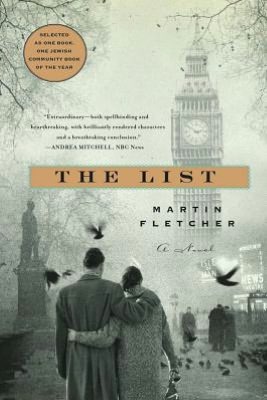
The List

The List by Martin Fletcher

What was it like to have been one of the few Jews that managed to get out of Germany, Austria or Poland before the Nazis rolled in and took control?  This story, written as a novel by journalist and foreign correspondent Martin Fletcher, is basically a story about Fletcher's parents.  Fletcher incorporates his family's story into his narrative of a young Jewish family, Holocaust survivors, struggling to stay afloat in their adopted country of London, England.  This poignant and heart wrenching story opens in London with the celebration of Germany's surrender.  But the war does not end with VE Day for Georg and Edith, a newly married couple, anxiously hoping to start a family and a new life, while at the same time awaiting word on the fate of their loved ones.  They each keep a List of the names of their family members. 

As they struggle to start over, each day brings the anguish of no news about their family or confirmation of another family member or friend who was murdered in the Holocaust.  They tearfully cross off another name from their list.  Edith eventually gets word her beautiful cousin Anna has survived and will be coming to London.  But Anna's stay in Auschwitz has changed her beyond recognition.  Fletcher not only successfully recreates this world where the survivors are caught in limbo, but he also reopens a painful chapter in London history. 

While Edith and Georg struggle to rebuild their lives, they face the threat of a growing anti-semitism movement in London.  Englishmen are starting to resent the Jewish refugees taking homes and jobs, as their soldiers return home to unemployment and shortage of housing.  They want to expel the Jewish refugees and send them back to their home countries.  After Edith makes a speech at a meeting about repatriation petitions, Georg becomes a target for retribution. Their mysterious neighbor, Ismael, an Egyptian Arab living at the boarding house, steps in to protect Georg.  This introduces a whole new subplot with possibly deadly consequences for Georg, Edith and Anna.

This deeply touching novel explores the themes of hope, prejudice, loss and love. It is both a breathless thriller of postwar sabotage and a heartrending and historically accurate portrait of an almost forgotten era.  This is what is meant when they say a good book transports you to another time and place.

Monday, September 17, 2012

My Lady Judge by Cora Harrison

My Lady Judge: A mystery of Medieval Ireland 

by Cora Harrison

I actually bought this book in a bookstore in Milan, Italy four years ago.  I really enjoy this kind of historical fiction.  Harrison does a tremendous job of recreating life and the kinds of characters in medieval Ireland.  At this in Irish or Celtic history, it is not unusual for a woman to hold such a powerful and prestigious position as a Brehon (Judge).  And Mara is a strong, and intelligent protagonist, who rules not only with her brain, but equally with her heart.  Mara, appointed by the King, is the Brehon for the Irish kingdom of the Burrens, located on the western seaboard of Ireland, in what is now Connemara County.

Mara uses her powers of observation to solve crimes, whether it is the murder of one of her assistants or the disappearance of a neighbor's cow.  There is quite a list of interesting characters, all nicely developed by Harrison.  While she is introducing and setting up the plot, she cleverly weaves a description of specific ancient Brehon laws and how Mara administers these ancient laws.  As previously stated, the novel is set in medieval times, just at the time that a young Henry VIII ascends to the throne of England, which follows a much more harsh and brutal system of Roman laws.  As I have said before with other well written and researched historical novels, it is an exciting way to learn about different aspects of history.  In addition to the history lesson, you will find yourself immersed in the plot, the characters and the conflict that naturally develops between the Catholic faith, trying to establish a foothold in Ireland, and the people's adherence and belief in ancient Celtic practices and laws.

This is a series of novels by Cora Harrison with the Lady Judge Mara as the main character.  You can't go wrong if you choose to introduce yourself to any of Harrison's Brehon Mara's stories.

Saturday, September 15, 2012

Van Gogh: The Life

Van Gogh: The Life by Steven Naifeh and Gregory White Smith

I believe you have to be a Van Gogh fanatic, as I am, if you are willing to pick up this 950+ page biography on this phenomenal painter, who lived to see only one of his paintings sell.  This is a heavy read in more ways than one.  The authors are the Pulitzer Prize winning team who wrote Jackson Pollock: an American Saga.

The first 400 plus pages primarily deal with Van Gogh's life before he decided to start painting.  While it was informative, it did get to be somewhat repetitive in terms of his relationship with his parents, his behavior and his uncertainty of what he really wanted to do with his life.  This part of the book did tend to drag at times.  When Van Gogh made the decision to start painting, is when the book became more engaging and interesting.  The best parts of the book include the author's descriptions of Van Gogh's thinking and motivation as he was creating his many masterpieces.  

Working with the full cooperation of the Van Gogh Museum in Amsterdam, Naifeh and Smith had access to a wealth of previously untapped materials. They draw liberally from the artist’s famously eloquent letters, while delving into hundreds of unpublished family correspondences, illuminating with poignancy the wanderings of Van Gogh’s troubled, restless life.

The authors also call into question the accuracy of Van Gogh's supposed "suicide".  There has always been questions about whether Van Gogh really shot himself.  Naifeh and Smith carefully analyzed the accounts and information surrounding Van Gogh's death, and in the Appendix of the book provide a "legally defensible theory" that Van Gogh died as a result of an accidental shooting from a young teenager that frequently harassed him as Van Gogh went into the fields to paint.

This is an exceptionally detailed, and at times compellingly readable, but ultimately heartbreaking portrait of the creative genius of Vincent van Gogh. The fact that I was traveling to Provence (Arles and St. Remy) this summer also compelled me to start reading this biography.  It is ironic that most of Van Gogh's contemporaries and family never believed he would amount to anything.  In fact this biography reveals how frequently Van Gogh received little to no inspiration or motivation to paint.  Only his brother Theo provided encouragement and support, but even then his support was lacking at times.  This constant criticism obviously wore on Van Gogh, as is illustrated in these words from Van Gogh to his brother Theo, "As a painter I shall never amount to anything important, I am absolutely sure of it."

However, this other statement written by Vincent while living in Arles, in southern France, perhaps best illustrates his passion for painting.  "My aim in life is to make pictures and drawings, as many and as well as I can, then, at the end of my life, I hope to pass away, looking back with love and tender regret, and thinking, 'Oh, the pictures I might have made!"  While he never lived to experience what his paintings have meant to society, thank goodness he persevered.  In a very short time, Van Gogh created some of the world's greatest works of art.  "Oh, the pictures he might have made!"

Wednesday, June 6, 2012

2012 RHS 11th and 12th Grade Summer Reading List

RHS 11th & 12th Grade Summer Reading List

When entering your comments, be sure to include the Title of the Book you read first before typing your comments about the book.

Be sure to sign your name at the end of your comments.